
Ethiopia is poised to overtake Indonesia as the world’s fourth largest coffee producer in the 2026/27 marketing year, marking a shift in the global coffee industry and reinforcing the country’s emergence as one of the fastest growing coffee exporters in the world. According to the latest U.S. Department of Agriculture (USDA) Coffee Annual report, Ethiopia’s coffee production is forecast to reach 12.1 million 60 kilogram bags in 2026/27, compared to Indonesia’s projected 11.38 million bags.
If the forecast materializes, it would mark the third time in five years that Ethiopia has surpassed Indonesia in total coffee output, following the 2023/24 and 2024/25 seasons. The development reflects not only contrasting weather conditions between the two countries, but also deeper structural changes taking place within Ethiopia’s coffee sector. While excessive rainfall disrupted Robusta flowering in Indonesia during mid 2025, Ethiopia benefited from favorable rainfall patterns and improving agronomic conditions across major coffee growing regions.
The projected increase would also extend Ethiopia’s streak of annual coffee production growth to four consecutive years. National output has risen steadily from 11.46 million bags in 2024/25 to 11.56 million bags in 2025/26 and is now expected to climb further to 12.1 million bags in 2026/27. Over the last two decades, Ethiopia’s coffee production has nearly tripled, increasing from around 4.5 million bags in 2005/06.
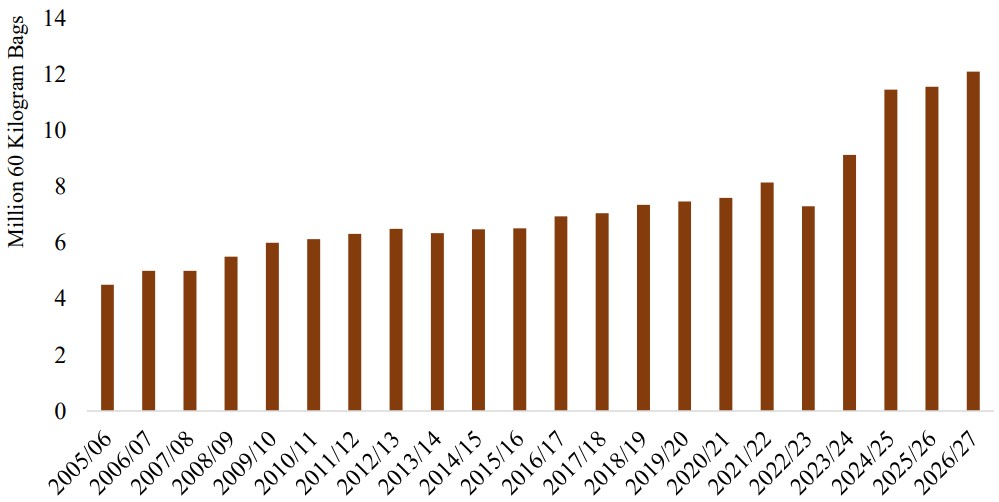
Fig: Ethiopia's Annual Coffee Production Estimates (MY 2005/06 - 2026/27) / Source: USDA Coffee Annual Report on Ethiopia (May 20, 2026)
Behind the expansion is a combination of favorable climate conditions, government backed rehabilitation programs, rising private sector investment, and gradual modernization of farming systems. Ethiopia’s harvested coffee area is forecast to reach 800,000 hectares in 2026/27, while the number of bearing coffee trees is expected to increase to 2 billion.
The growth trajectory is particularly notable because Ethiopia’s coffee industry remains overwhelmingly dominated by smallholder farmers. According to the Ethiopian Coffee and Tea Authority, approximately 5.9 million farmers are currently engaged in coffee production, with smallholders accounting for around 90% of total national output. Most producers cultivate coffee on plots of less than half a hectare, often integrating coffee into mixed farming systems alongside food crops.
However, productivity improvements are increasingly reshaping the sector. Farmers across producing regions are adopting practices such as pruning, composting, soil management, intercropping, and tree stumping to rehabilitate aging coffee farms. The national stumping campaign, launched four years ago, has become one of the sector’s most important productivity initiatives. According to the USDA report, nearly 70% of Ethiopia’s coffee trees are old, with some estimated to be more than 100 years old. Yet rejuvenated stumped trees are now beginning to deliver significantly higher yields.
ECTA estimates that 15% of Ethiopia’s harvested coffee area in 2025/26 consisted of stumped coffee trees, with Oromia recording the highest adoption rate at 19%. Studies conducted in Sidama and South Ethiopia reportedly show that stumped trees can increase yields by as much as threefold within four years.
At the same time, Ethiopia’s agricultural research system is increasingly introducing improved hybrid varieties with higher yields and stronger disease resistance. The Ethiopian Agricultural Research Institute reports that more than 50 improved varieties have already been distributed nationwide. Under better management conditions, these hybrid cultivars can produce around 2.8 tons per hectare, compared to the current national average yield of less than one ton per hectare.
The government is also attempting to transform the structure of the sector itself. In one of the country’s most ambitious coffee sector reforms, authorities have allocated 100,000 hectares of land for large scale commercial coffee development. This marks the first major effort to establish mechanized coffee farming systems at scale in Ethiopia.
Officials describe the initiative as a strategic attempt to move beyond Ethiopia’s traditional dependence on fragmented smallholder production toward a hybrid system combining traditional farming with commercial plantations and technology-driven production methods. According to the USDA report, 110 private investors have already received land allocations in Oromia and Southwest Ethiopia regions, although planting has not yet begun.
The proposed commercial farms are expected to adopt mechanized land preparation, structured planting systems, smart irrigation technologies, and modern machinery comparable to systems used in Brazil. Industry analysts believe the strategy could improve consistency, productivity, and export competitiveness, although some stakeholders remain concerned about the impact mechanization could have on Ethiopia’s distinct coffee flavor profiles.
Coffee production in Ethiopia also remains highly concentrated geographically. Oromia accounts for 59.5% of national production, followed by Southwest Ethiopia at 13.7%, Sidama at 12.9%, and South Ethiopia at 7.1%. Together, these four regions account for roughly 93% of national output.
Ethiopia’s rise in global coffee rankings is also being driven by expanding export revenues and diversification into new international markets. In the 2024/25 marketing year, Ethiopia exported 7.43 million bags of coffee valued at USD 2.89 billion, representing a 31.9% increase in volume and a 69.4% increase in value compared to the previous year. Coffee now generates nearly one-third of Ethiopia’s total export revenue, making it one of the country’s most strategic export sectors.
Saudi Arabia and Germany remained Ethiopia’s largest export destinations, collectively accounting for nearly one third of export volumes. However, the most dramatic development has been the rapid emergence of China as a major market for Ethiopian coffee. Exports to China surged by 264.1% in 2024/25 to 670,000 bags valued at USD 274 million, making China Ethiopia’s third-largest coffee buyer.
China’s expansion reflects broader changes in global coffee consumption patterns. According to the USDA report, China’s coffee market was valued at approximately USD 42 billion in 2024, while national coffee consumption reached 6.3 million bags. The rapid growth of café chains, e-commerce delivery platforms, and specialty coffee culture among younger urban consumers is transforming China into one of the world’s fastest-growing coffee markets.
Chinese importers and investors are also becoming increasingly active within Ethiopia itself. According to USDA, several Chinese firms are exploring investments in coffee processing facilities and premium instant coffee production in Ethiopia’s agro industrial parks.
Despite the strong long term outlook, Ethiopia’s coffee sector continues to face mounting operational pressures. During the 2025/26 season, exporters and washing station operators reported severe challenges arising from record cherry prices, rising labor costs, logistics disruptions, and fuel shortages. In some producing regions, cherry prices reportedly quadrupled compared to previous seasons, while labor costs for coffee picking doubled from five Birr to ten Birr per kilogram.
Exporters further stated that shipping costs per container increased by approximately 60%, while disruptions at the Port of Djibouti and fuel shortages created delays in export movements. These operational constraints contributed to a 13% decline in coffee exports during the first half of the 2025/26 marketing year.
Meanwhile, tighter international regulatory requirements are beginning to reshape Ethiopia’s export environment. The European Union’s Regulation on Deforestation Free Products, which takes effect from late 2026, will require extensive traceability systems and geolocation mapping across Ethiopia’s fragmented smallholder farming structure. Industry stakeholders warn that compliance costs, weak digital infrastructure, and the complexity of tracing coffee across millions of farms could create significant implementation challenges.
Nevertheless, according to USDA, industry analysts remain optimistic about Ethiopia’s long term position within the global coffee market. Climate suitability studies cited in the USDA report suggest Ethiopia could become one of the few major Arabica-producing countries where suitable coffee growing areas continue expanding in the coming decades, even as countries such as Brazil, Colombia, and Honduras face increasing climate related pressures on production.
If current trends continue, Ethiopia’s rise above Indonesia may represent more than a temporary change in rankings. It could signal the emergence of Ethiopia as one of the defining long term growth stories in the global coffee industry.
Source: USDA Coffee Annual Report on Ethiopia (May 20, 2026) and Ecofin Agency