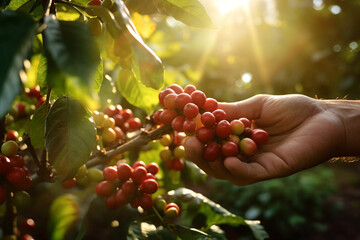
Global coffee production and consumption are both expected to reach record levels in the 2026/27 marketing year, with Ethiopia emerging as one of the sector's strongest performers, according to the latest Coffee: World Markets and Trade report released by the U.S. Department of Agriculture (USDA).
The USDA forecasts global coffee production to increase by 10.8 million 60-kilogram bags to an all-time high of 189.7 million bags, driven by record harvests in Brazil, Ethiopia, Uganda, and Vietnam. At the same time, worldwide coffee consumption is projected to climb to a record 179.7 million bags, reflecting growing demand, particularly in the European Union and the United States.
The increase in production is also expected to push global coffee bean exports to a record 131.4 million bags, while ending stocks are forecast to rise for a second consecutive year to 26.3 million bags. As supplies improve, international coffee prices have already fallen by approximately 25 percent over the past seven months, according to the International Coffee Organization's composite price index cited in the report.
Brazil, the world's largest coffee producer, is expected to harvest a record 71.9 million bags, supported by a strong recovery in Arabica production after several years of weather-related setbacks. The rebound reinforces Brazil's dominant position, with the country accounting for nearly 40 percent of global coffee production.
For Ethiopia, the outlook is equally positive.
The USDA projects Ethiopian coffee production to reach a record 12.1 million bags in 2026/27, an increase of more than 500,000 bags from the previous season. The report attributes the growth to higher cultivated area and improved yields, noting that more than half of the country's coffee-growing area has been replanted with higher-yielding coffee varieties over the past four years.
Ethiopia's coffee bean exports are forecast to rise by nearly 200,000 bags to 7.1 million bags, supported by the larger harvest. However, domestic coffee consumption is also expected to continue expanding, reaching a record 5 million bags, reflecting the country's strong coffee-drinking culture and growing local demand.
The report indicates that Ethiopia has become one of the countries helping to strengthen global Arabica supplies during recent years. As Brazil struggled with drought, frost, and extreme temperatures that reduced Arabica production, countries including Ethiopia, Mexico, and Peru expanded output to partially offset the global supply shortfall. Nevertheless, those gains were insufficient to fully compensate for Brazil's losses, contributing to a sharp decline in global coffee stocks between 2020/21 and 2024/25.
Although global inventories are now expected to recover for a second consecutive year, the USDA notes that ending stocks will remain below their long-term average, suggesting that market conditions will continue to depend heavily on Brazil's production cycle despite record output elsewhere.
Source: USDA World Markets and Trade Report (July 2026)